
by Cherie Dawn Haas
Someone who is writing their first book reached out to me recently to ask: how do I organize the chapters? When writing fiction, there are a few ways I keep track of the plot and characters, but one stands out like no other: Index cards.
I first used index cards when I was on my fifth or sixth draft of Girl on Fire. Prior to that, I kept a spreadsheet to list what happened when, who was in that section, and how the chapter moved the book forward.
When something needed more work (BTW, everything always needs more work), I would highlight it in red, and after I addressed the issues I would gray out the text. This worked until I brought in the big guns.
My first professional editor read my draft and told me what I needed (not wanted) to hear: the story didn’t really begin until about halfway through, and up until that point it was kind of boring because the characters weren’t experiencing any struggles.
Her advice: note each chapter on an index card, including one or two words about what the chapter feels like. Examples: was my protagonist happy, frustrated, experiencing growth or hurt? Did the chapter actually do anything to move the plot forward, or was it only fluffing my word count?
After evaluating this, I laid out the cards and then began moving them around on the floor until I had a story arc. Then, my novel clicked together and I had something that was interesting and engaging.
I published Girl on Fire and threw a party.
A few years later, here I am writing two more books. The first I’ll tell you about is another work of fiction. Remembering much of what I learned from my first novel, I wasted no time in getting out a stack of index cards to first lay out my plot. (The characters were already fairly solidified in my mind.)
I jotted down the notes, breaking down each plot point in the simplest form possible because as the story unfolded, I saw new ways to make it more interesting by changing what happens when, and planning some of the foreshadowing elements. I moved them around until it read like a movie, and then asked my husband to take a look so I could get someone else’s opinion.
I was in my element as I explained that “this happens here, and then so-and-so does that,” etc. He liked it!
Since I had confirmation that it was a decent start, I then began writing these chapters. With each one written, I added notes to the index cards, including the date of each event.
The dates may not end up in the final version, but they’re crucial to the logical flow of the plot and the character interactions. I chose the 2018 calendar as a reference so that my weekdays, weeks, and months made sense, at least to me as I wrote the story.
When the plot changed from my plan, I simply tore up the index card and made a new one. As they came together, I taped them to a large sheet of craft paper (a 3-foot wide roll that I continued to unravel as needed). When I hit word-count goals I put a sticker on it, and when I needed encouragement I wrote something positive in glitter. It became a mixed-media project of sorts.
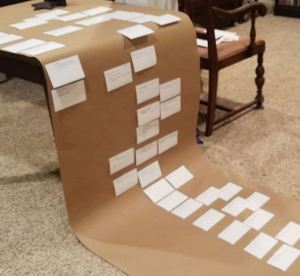
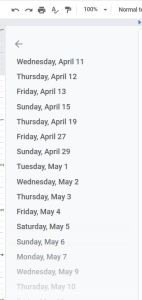
Let’s go back to the dates for a moment…one of the benefits of using fictional dates on the index cards is that when I was writing the novel – I write in Google doc – I was able to use the Outline function to more easily navigate the 130-page document. The dates were the only identifier to find specific places in the book that I was working on.
How I Used Index Cards as an Outline When Writing a Novel
For example, if I was re-writing the chapter that took place on May 13 and realized that something else needed to happen before that in order for it to make sense, I would refer to my index cards to see where I next needed to make an edit. Then I could look at those in between to see at a glance if there was anything else that was affected by this change.
It wasn’t foolproof, of course, because there are so many details to check, but it made the process of writing a novel a little less intimidating. Can’t we all use a little help in that department?
Organizing a Book of Poetry
Another writing project I’m working on is to finally publish a book of my poetry. I wanted to include a couple of pieces of prose and short stories, and found it was easy enough to organize the larger pieces of content.
I started with the poetry that was my main inspiration, and after which the book is titled after. The next chapter is additional poetry that is outside of that main theme; followed by the prose, which is closely related to poetry in the lyrical sense; followed by the short stories.
After sharing these works with my editor, he came back with a suggestion: to consider the flow of the poems within each chapter.
Sound similar? Let me insert some advice here: get the professional opinion of others when it comes to your writing if you want to publish it. You don’t have to do this alone.
Back to the poetry book…for the first time I looked at the poems on a more individual level. I had already separated them into two obvious groups, but after that just threw them all in.
If you’ve read this far, you know what I did next. Index cards for the win!

The book of poetry is on schedule to be published by July, and I’m hoping to have my next novel published in 2021, so stay tuned, and stay inspired.
Peace, love, and creativity,
Cherie Dawn


 LifeSoup by Cherie Dawn Haas
Leave a reply to Stuart Danker Cancel reply